

Key takeaways
- AI infrastructure investment is approaching USD1 trillion a year, flowing across 30 nodes in an increasingly interconnected data centre value chain.
- Chips and servers capture half of investment, but investment in power grids and digital networks across sectors and players is becoming equally strategic.
- Supply constraints could determine the pace of the AI build-out, with critical bottlenecks in some areas.
AI infrastructure investment across sectors and players is approaching USD1 trillion annually as spending accelerates across AI chips and servers, power grids and cooling, networking equipment and data centre construction. In a recent report, BNP Paribas Equity Research maps the AI capex flows through 30 of the most important segments of the value chain, explains how each supports AI data centre build-out and infrastructure, and identifies the bottlenecks that could determine the pace of the build-out.
Following the money across the AI value chain
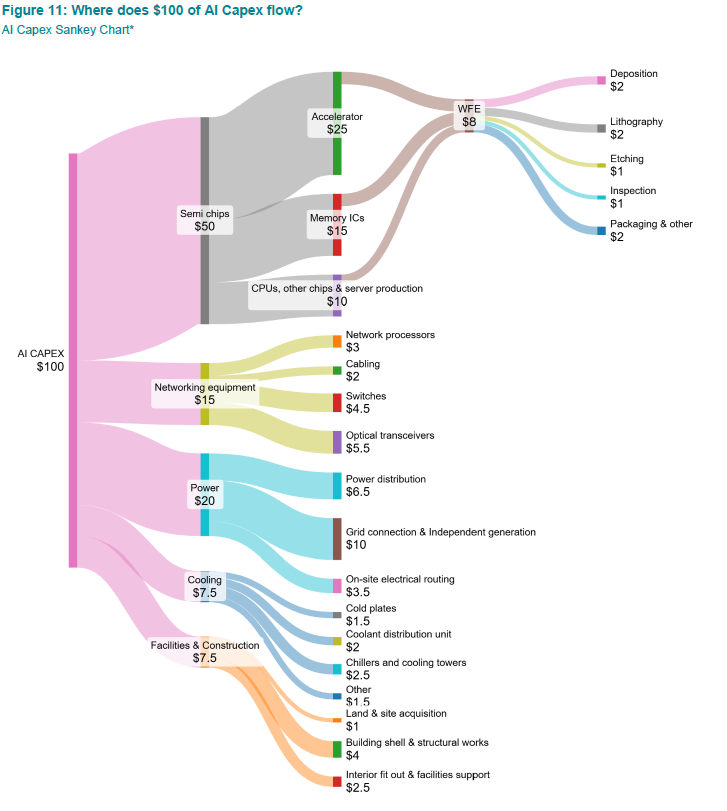
Our experts look at allocations across chips and servers at 50%, followed by power and cooling at almost 30%, as well as networking equipment and facilities & construction.
Source: BNP Paribas Equity Research, SankeyMATIC
*high level estimates subject to change given rapidly shifting costs and demand-supply dynamics.
Why chips and servers capture 50% of AI capex
BNP Paribas Equity Research analysts look at AI chips for use in AI servers, the assembly of the servers themselves and wafer-fabrication equipment, all of which account for half the total investment across the value chain. Beyond the capex involved, they assess the pace at which sector players will move towards new technologies, such as methods of feeding electricity to chips, including shifts from existing-hardware-aligned low voltage frameworks towards 800V architecture, which means advanced power management integrated circuits (PMICs) and a redesigned data centre layout.
AI accelerators – specialised hardware components used to execute AI and machine learning tasks like training and inference quickly and efficiently – account for half of this item. As agentic AI shifts more computing demand from model training towards inference, our experts examine how this change could affect competition and margins across the sector. Meanwhile in memory integrated circuits, the key debate centres on pricing for dynamic random-access memory (DRAM), high bandwidth memory (HBM), and NAND flash memory, and whether recent price increases and supply-demand imbalances mark a lasting shift away from the memory market’s historically cyclical pattern.
Our experts also note that agentic AI is changing the balance of demand within central processing units (CPUs), other chips and server production as inference moves towards c.60% of compute demand in 2026.

❝ AMD estimates suggest that the data centre CPU total addressable market could rise from around USD26 billion in 2025 to around USD220 billion in 2030, and we see agentic AI affecting the ratio of GPU to CPU demand. ❞
Crucial to the AI build-out: power grids and cooling facilities
AI data centres require substantial, reliable electricity supplies with investment needed in power generation, transmission, grid connections, distribution equipment and on-site electrical systems. Roughly 20% of AI investment therefore goes to power utilities and transmission, independent generation, power distribution equipment, and on-site electrical routing, reflecting grid-connection delays and growing interest in on-site power from gas turbines, renewables and fuel cells.

❝ As the data centre share of electricity demand grows, power grids will be key and we see a large proportion of investment going to generation, transmission and distribution. ❞
In cooling, BNP Paribas Equity Research analysts assess whether water scarcity and local opposition to data centre development could accelerate the shift towards closed-loop dry cooling systems.
Networking equipment: 15% of AI hardware investment
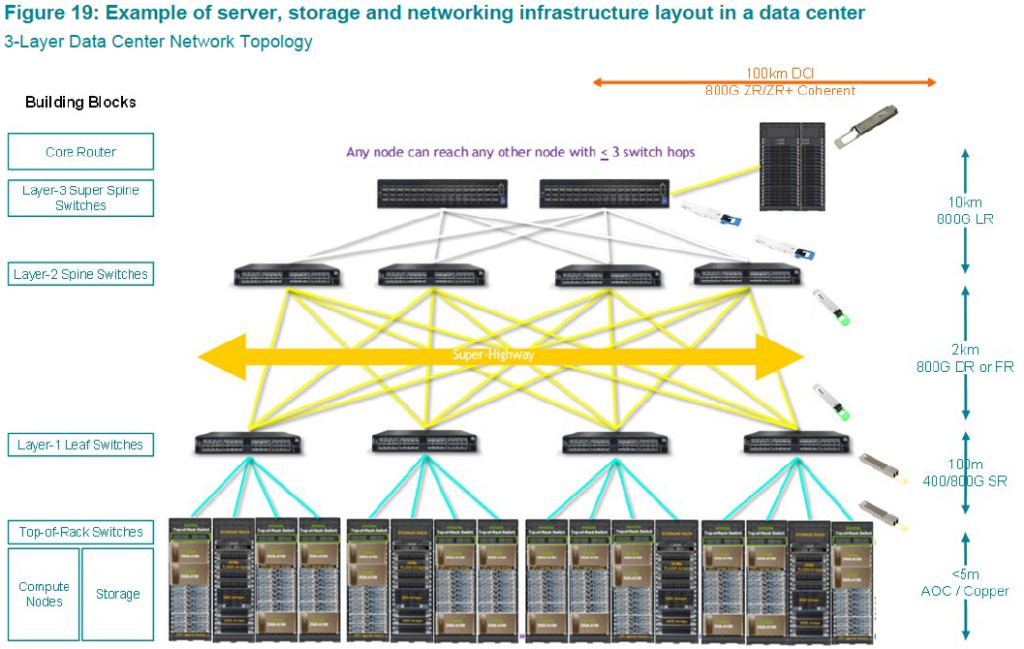
Networking equipment accounts for around 15% of AI hardware investment. Back-end networking links accelerators and servers to train and run AI models, while front-end networking connects data centres with external users and applications. This infrastructure includes network processors, switches, cabling and optical transceivers.
According to our experts, key questions for the sector include market share dynamics between Ethernet and Infiniband switches, as well as the potential US supply vulnerabilities for components such as optical transceivers, given China’s significant role in producing indium phosphide, a key material used to turn electricity into laser light.
Source: Fiber Mall and BNP Paribas, TAMing the AI Universe
The biggest bottlenecks in AI infrastructure
BNP Paribas Equity Research identifies several critical AI infrastructure bottlenecks that may be difficult to resolve over the next few years: from advanced logic foundry and packaging, to lithography, memory, optical transceivers and grid connection. Developments in AI regulation will also be key.
FAQ
How much is being invested in AI hardware?
Annual AI hardware capital expenditure is closing in on USD1 trillion across 30 interconnected parts of the data centre value chain.
Where does most AI hardware investment go?
It goes to chips and servers that provide the core computing capacity needed to train and run AI models, with demand increasingly shaped by the shift from model training towards inference. Chips and servers account for the largest share at 50%, power infrastructure 20%, networking equipment 15%, and cooling and facilities & construction at 7.5% each.
What could slow the expansion of AI infrastructure?
Scarce supply and concentrated production: advanced logic foundries, advanced packaging, DRAM and high-bandwidth memory, grid interconnections, lithography equipment and indium phosphide optical transceivers.
For Institutional Clients only – For more details on BNP Paribas Equity Research, please visit:
Cash Equities | Global Markets
BNP Paribas does not consider this content to be “Research” as defined under the MiFID II unbundling rules. If you are subject to inducement and unbundling rules, you should consider making your own assessment as to the characterisation of this content. Legal notice for marketing documents, referencing to whom this communication is directed.


