

Key takeaways
- Improving market conditions support a sustained recovery – greater investor confidence, valuations and normalising conditions unlock transactions.
- The UK continues to attract both domestic and international interest, underpinned by strong businesses, global reach and attractive valuations.
- Momentum is expected to continue into 2027, supported by corporates looking for strategic opportunities, financial sponsors and a more stable geopolitical environment.
As Mergers & Acquisitions (M&A) activity gains momentum across the UK, investors are navigating a market shaped by stabilising conditions, attractive valuations, and renewed confidence.
We sat down with Kirshlen Moodley, Head of UK Advisory at BNP Paribas CIB, to discuss what’s driving today’s market, why the UK continues to attract international investors and what lies ahead for the remainder of 2026 and beyond.
The first half saw dealmaking hit significant highs in the UK and with BNP Paribas taking noteworthy market share. What drove this stellar increase in M&A activity?
Over the past few years, many strategic transactions were delayed as investors and businesses navigated higher interest rates, geopolitical uncertainty and a rapidly changing macroeconomic environment. What we are seeing now is not a sudden surge, but a market that is normalising and functioning as expected again.
In the UK specifically, financial markets have stabilised and investors have gained greater confidence in assessing risk. Transactions that had been on hold are moving forward. Companies are returning to long-term strategic decisions with greater clarity around financing, valuations and execution. The appetite to do deals was always there; the difference today is that boards and investors are more comfortable acting on it.
The numbers reflect this improvement with BNP Paribas taking noteworthy market share. In the UK, M&A value nearly tripled YoY to GBP292 billion, underpinned by transformational strategic deals; with the number of deals with more than GBP1 billion in value, more than doubling to 50. A broader, significant uptick in inbound (+81%) and domestic (+55%) volumes further supported the momentum.

❝ With greater clarity around financing, valuations and execution, company boards and investors are acting. Moving ahead with transactions that had previously been on hold, as well as seizing new opportunities to deliver on their long-term strategic goals. ❞
Looking more broadly to Europe, BNP Paribas played a leading role in the EMEA M&A market this first half, advising on more than USD230 billion of announced M&A volumes in H1 2026 and ranking #3 in the Dealogic league tables, on the back of our advisory franchise across strategic and cross-border transactions. The Bank was named Best Investment Bank in EMEA in the recent Euromoney Awards for Excellence, reflecting our clients’ trust as well as the breadth and depth of our platform across equity capital markets, debt issuance, sustainability finance and strategic advisory. In equity capital markets, BNP Paribas led 77 transactions across EMEA and ranked first in deal count among all bookrunners.
Do you see the strength seen in the first half of the year in the UK as the beginning of a sustained recovery, or driven by short-term opportunities? What is driving the strong performance?
I see this less as a short-term spike, and more as the normalisation of dealmaking. Financial institutions illustrate this trend particularly well, with activity accelerating significantly through high-profile transactions. More stable markets and stronger investor confidence have helped create a more supportive environment for deals that have been under consideration for some time.
UK M&A volumes and value (public & private)
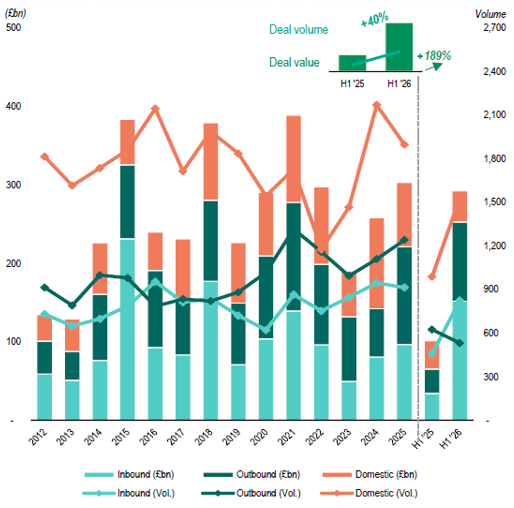
Source: BNP Paribas, Dealogic, as of 30/06/2026
Median UK deal size evolution (private + public)
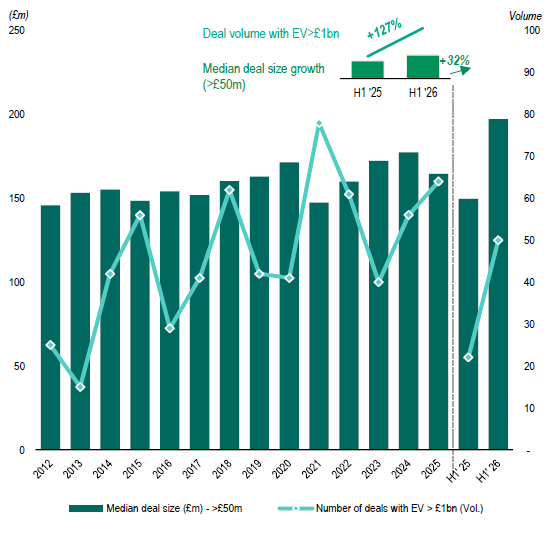
Source: BNP Paribas, Dealogic, as of 30/06/2026
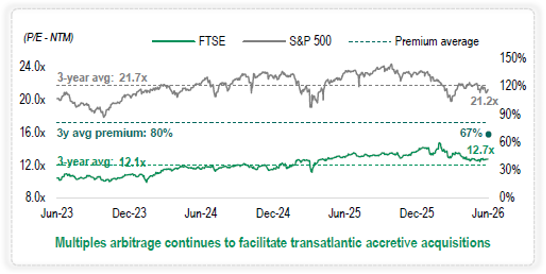
The UK has always been an active M&A market, both domestically and from an inbound investment perspective, particularly from the US, the largest market contributing more than 50% of inbound investment in H1 2026. This reflects the strength and attractiveness of UK businesses, with strong fundamentals, international exposure and attractive market positions. At the same time, the valuation gap is driving deals. While sterling has strengthened against the US dollar, UK-listed companies continue to trade at lower valuation multiples than comparable US businesses, creating opportunities to acquire high-quality UK assets with strong international franchises.
The UK / US benchmark valuation multiples gap is narrowing but still attractively low
We have seen this dynamic reflected in transactions such as TIAA-Nuveen’s GBP9.9 billion recommended all-cash offer to acquire Schroders, highlighting confidence in the UK asset management industry and the long-term strategic value investors continue to see in the UK market. BNP Paribas acted as Financial Advisor to Nuveen in its GBP9.9 billion (USD13.5 billion) recommended all-cash offer to acquire 100% of Schroders. The combined group will have nearly USD2.5 trillion of assets under management (“AUM”) and showcases BNP Paribas’ strength in complex cross-border transactions, expertise across Advisory, Loan Capital Markets, Debt Capital Markets, FX and Securities Services, and integrated One Bank approach.
We are also seeing a more active shareholder environment, with investors increasingly focused on unlocking value through strategic reviews, portfolio simplification and M&A creating an additional catalyst for corporate activity across the market.
We have seen a recent pick-up in outbound activity with UK-based companies targeting undervalued European peers. What is driving this?
Following a more subdued period, management teams are showing renewed appetite for international expansion to develop their international footprints, consolidate their market positioning, diversify and create new growth opportunities, with outbound transactions accounting for 35% of the total transaction value in H1 2026.
Corporates are using outbound M&A to build scale, pursue sector-specific opportunities and strengthen their international positions. Many companies have strong balance sheets and are looking beyond their domestic markets to capture growth.
Strategic buyers are increasingly active
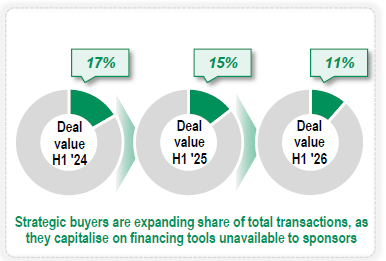
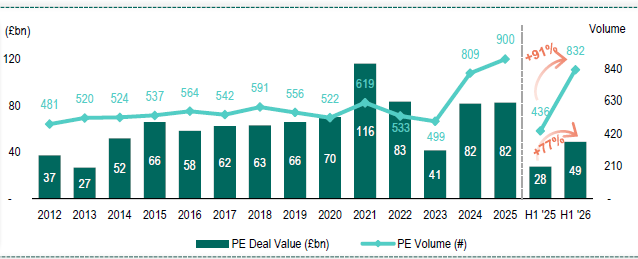
Private equity sponsors have also adapted, with activity increasing in both transaction volume and deal value compared with H1 2025. As financing conditions stabilise and exit opportunities become clearer, sponsors are showing greater confidence in deploying pent-up capital, with a sharper focus on value creation and credible exit strategies.
Private Equity activity is picking up
Private Equity firms have had significant capital to deploy, but are investors simply under pressure to do deals, or are there broader factors driving investment decisions in today’s M&A market in the UK?
Private equity firms focus on acquiring high-quality companies, creating operational value, and achieving attractive returns. With returns no longer supported by low-cost of debt, firms now need to unlock more value through operational improvements, growth strategies and long-term transformation.
At the same time, investors are evaluating opportunities through a broader lens than simply local market conditions. Financing should be viewed from a global perspective. An acquisition in the UK can be financed through a variety of options, including in GBP, the home currency, but also via cross-currency swaps in euros and dollars to optimise the interest rate mix in the financing solution for a transaction. As a universal bank with a global footprint, BNP Paribas banking teams can offer the full financing playbook to corporates and financial sponsors.
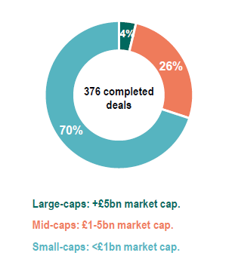
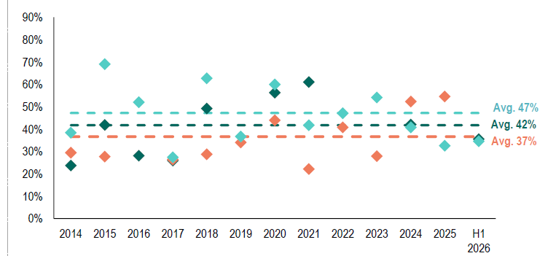
The attractiveness of UK public companies is also reflected in takeover dynamics. While UK acquisitions have historically been completed at meaningful premiums, the majority of public M&A activity has focused on small-cap companies, highlighting the depth of opportunities available across the market.
UK M&A activity since 2014 vs UK public takeover bid premia
Source: BNP Paribas CIB, CapitalIQ as at 30/06/2026.
Until recently, exit visibility was one of the biggest challenges for private equity buyers of UK listed companies. Uncertainty in the IPO market made exits more difficult to predict. However, as markets stabilise, confidence around exits is improving, shifting the question from whether a good company can be acquired, to whether it can create enough value and a successful exit at an attractive valuation.
As Head of UK Advisory, how do you see the second half of the year shape up for the UK market?
Based on what we’re seeing today, I would expect the strong momentum from the first half of 2026 to carry through to the remainder of the year, supported by the pipeline and also by the broader level of activity across the market. Looking further ahead, I see little reason why this momentum should not extend into 2027.
The recovery appears increasingly sustained rather than short term. In sum, investors are becoming increasingly comfortable with the exit environment, the valuation gap between the UK and other markets continues to create opportunities, strategic buyers remain active, and private equity firms still have significant capital to deploy.
At the same time, financial markets remain stable, there are no obvious signs of a valuation bubble, and financing markets continue to support deal activity. We expect continued derisking of portfolios, further strategic moves from corporates and increased confidence among sponsors.
Financing will remain a key differentiator. The end of very cheap financing means buyers must focus more closely on the value they can create from an asset, while access to funding across sterling, euro and US dollar markets continues to create attractive financing and arbitrage opportunities.