

Over the past decade, the profession has evolved from mastering the basics of cash management to navigating the frontiers of digital transformation, regulatory change, and artificial intelligence. This landmark report, produced in partnership by BNP Paribas, EACT, PwC, and SAP, distils the lessons learned and the opportunities ahead for treasurers across Europe and beyond.
Refocusing on fundamentals
The 2025 European Association of Corporate Treasurers (EACT) Survey reveals a clear shift in priorities. Treasurers are adopting a back-to-basics approach with a fresh focus on cash flow forecasting, liquidity visibility and operational resilience. In a year marked by macroeconomic volatility, rising interest rates, and geopolitical uncertainty, these fundamentals have become the bedrock of treasury strategy.

❝ Marking a decade of client support and collaboration, EACT, PwC, SAP and BNP Paribas offer insights in the Journeys to Treasury report, presenting forward‑looking trends and innovative solutions. As a trusted banking partner, BNP Paribas continues to accompany clients with these regular insights to navigate a changing landscape and help them achieve their long‑term goals. ❞
Cash flow forecasting has overtaken long-term funding to become the number one priority in the EACT Treasury Survey 2025, with almost one in three treasurers (30.5%) prioritising forecasting the most, above long-term funding, capital structure and the replacement of legacy technology infrastructure.
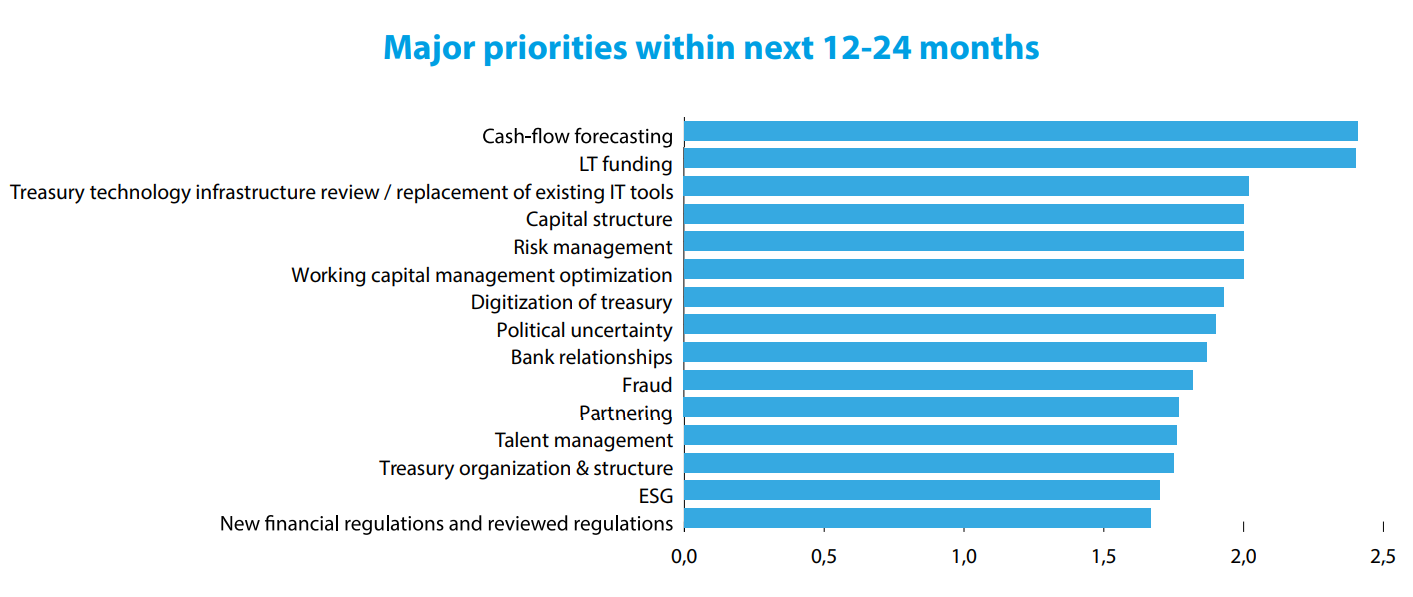
Source: EACT Treasury Survey 2025
Accurate forecasting is not just about predicting numbers. It supports working capital optimisation, funding strategies, and risk management. Yet, many organisations still grapple with semi-manual processes and still fragmented systems, exposing vulnerabilities and limiting agility.
Technology: adoption in layers
Digital transformation remains a central theme, but treasurers are approaching it with pragmatism. The survey highlights a strong appetite for upgrading technology, especially treasury management systems (TMS), payment factories, and in-house banks. However, legacy systems and fragmented architectures often slow progress, prompting a focus on fixing core infrastructure before chasing the latest innovations.
Reported interest in data analytics, cloud solutions, and robotic process automation (RPA) is strong. Treasury teams are using AI for forecasting, compliance, and workflow automation, with practical use cases emerging in intercompany lending, fraud detection, and working capital optimisation. Success depends on clean data, robust governance, and cross-functional collaboration. A recurring challenge is the talent gap. New tools require new skills, and many treasury teams are investing in training and education to bridge this divide.
The next milestone is clear: real-time visibility. Treasurers want to move beyond end-of-day reporting to instant access to financial data, enabling faster, data-driven decisions and stronger stakeholder confidence.
A revolution undergoing in the payment space
Payments are undergoing a revolution, making it a defining theme of this tenth anniversary edition. Implementation of the EU Instant Payments Regulation offers real opportunities for liquidity management, but also introduces risks, particularly as regards to fraud and integration complexity.
ISO 20022 is bringing structured data and universal messaging to the forefront, supporting everything from compliance screening to straight-through processing. Meanwhile, e-invoicing is becoming mandatory in many countries, digitising order-to-cash and procure-to-pay processes and enhancing visibility and automation.
Digital currencies and tokenised instruments are also promising new ways to manage liquidity and automate payments. And virtual accounts are gaining traction, offering instant visibility and streamlined reconciliation if integration hurdles can be overcome.
Navigating complexity
Regulation is both a driver and a challenge for treasury. ESG reporting, ISO 20022, EMIR, MiFID, PSD2, and capital rules are all top of mind, with compliance becoming increasingly complex.
Market volatility has returned as a major concern, with FX risk and exposure management rising up the agenda. Sustainability is also in focus, though day-to-day treasury involvement in ESG strategy varies widely. For many, compliance is the primary driver of ESG engagement, with actions concentrated on process changes and reporting rather than investment decisions.
Cyber risk and fraud prevention add another layer of complexity. The pandemic-era surge in attacks exposed the weaknesses of fragmented systems, prompting treasurers to invest in real-time monitoring, automated controls, and advanced analytics to strengthen defences.
To conclude, this survey shows a profession rooted in operational fundamentals, focused on cash, funding, forecasting, and risk management. Yet, the momentum surrounding real-time data, automation, and selective AI use suggests a quiet transformation already underway. As treasury evolves, the focus remains on balancing operational fundamentals with strategic innovation, building the foundations for a more agile, connected, and impactful future.