

Key takeaways
- Agentic AI in retail is expected to complement, not replace, existing retail channels. It could accelerate online adoption, broaden competition and shift marketing spend.
- Wider consumer uptake depends on building trust through transparent, unbiased recommendations.
- Impact to be incremental, reshaping discovery and advertising flows, leaving experiential and social retail largely intact.
In a recent report, BNP Paribas Equity Research identifies agentic AI in retail – autonomous artificial intelligence agents that can browse, compare and purchase products on behalf of shoppers – as an emerging retail channel that will be complementary to the current retail ecosystem. Analysts point to this emerging trend’s potential to reshape retail by accelerating online adoption, broadening competition and diversifying marketing spend.
Will agentic AI revolutionise the retail experience?
The BNP Paribas 2026 Survey of Shoppers indicates that while a meaningful percentage of consumers already use AI tools as part of their purchase journeys, building greater consumer confidence would unlock broader adoption of agentic AI in retail, as many remain cautious, with the distinction blurred between genuine recommendations and paid placements.

❝ We don’t expect it to topple existing retail channels, instead we think the landscape will evolve, favouring adaptable, AI-savvy and large-scale retailers. ❞
Agentic commerce: what is it?
While not yet live in the UK and Europe, agentic AI is already streamlining the existing retail process elsewhere. This emerging technology relies on fully autonomous AI agents that can decide and execute purchases for the consumer based on predefined goals, personal preferences and real‑time data. Shoppers can interact with these agents – typically large language models (LLMs) – that help them locate items and ask questions as if they were in-store. The shopper simply asks a question and the AI agent makes a recommendation drawn from many retailers, both aggregators and individual brands.
Who wins in an agentic Al retail world, brands or aggregators?
Comparing the effects of agentic AI on brands and aggregators, our experts note that early traffic redirection signals from LLMs based on global data suggest that aggregators attract a slightly larger share of AI-driven referrals than standalone brands. According to their research, the key factor is who has the richest, most structured machine-readable data that AI agents can ingest quickly and trust completely.
From a competitive standpoint, aggregators with exclusive brand partnerships gain stronger protection against price comparison pressures and margin erosion. Meanwhile globally recognised brands and aggregators with “AI-ready” websites are more likely to appear in AI agent/LLM-driven recommendations.
What is the true impact?
According to our Equity Research experts, while this model is built around workflow delegation, it is unlikely to replace all purchases, given the continued importance of experiential and social elements in retail and the channel’s nascent aspect. They expect agentic AI in retail to have three main impacts: accelerate the move away from brick‑and‑mortar stores, broaden the competitive landscape and reallocate advertising budgets.
❝ We do not see it fundamentally rebalancing economic power towards consumers, but rather streamlining the shopping experience. We view it as an incremental improvement rather than a disruptive breakthrough. ❞
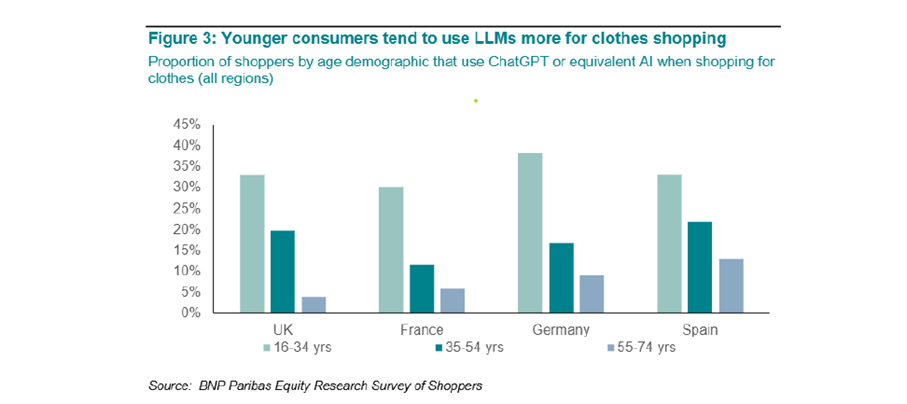
Given differences in consumer behaviour by age demographic, analysts see a rapid universal shift to agentic AI in retail as unrealistic. However, they expect it to expand the competitive landscape by enabling consumers to discover a wider array of brands more quickly, already amplified by social media. They conclude that the impact on brands will depend on the sophistication of their AI strategies.
With agentic commerce expected to divert consumer attention from traditional stores and websites toward agents and LLMs, our Equity Research experts see some advertising spending moving toward agents but expect the landscape to adjust and evolve.
❝ Early traffic redirection signals from LLMs suggest aggregators capture a slightly larger share of Al-driven referrals than standalone brands. ❞
Agentic commerce: unlocking the full power?
BNP Paribas Equity Research experts highlight certain points needed to harness the full potential of this emerging channel, such as consumer trust questions around AI, as agents may present sponsored content as unbiased advice; heavy brand specific training can cause the model to favour that brand. Free AI models are more prone to bias due to brand partner funding, whereas paid subscription models can afford more balanced, independent data.
Analysts also underscore data privacy concerns as customer information may be stored across different jurisdictions with unclear access rights, while data accuracy issues can also surface. Other questions involve delivery and returns, liability and malicious listings. Additionally, cybersecurity gaps can leave the agent’s decision-making logic vulnerable to hacker manipulation.
Key takeaways from the BNP Paribas 2026 Survey of Shoppers
Agentic AI in retail is just one development singled out in our annual survey of shoppers. Full conclusions are:
1) Cost-of-living crisis
Higher non‑discretionary costs still bite, but consumer outlook is less pessimistic for the third consecutive year.
2) What do consumers want to buy?
Leisure spending intent is stable year‑on‑year; intent to shop for clothes “for fun” has dropped, while intent to holiday abroad has risen.
3) Clothing demand
Overall clothing spend remains cautious; only the UK shows a modest rise, driven mainly by younger shoppers.
4) How do consumers expect to shop for clothing?
The anticipated split between store and online purchases is roughly the same as last year, with no clear shift toward online.
5) Is there a return to formal dress?
Except in Spain, consumers say they are not wearing more sportswear than a year ago, indicating sportswear is not gaining ground.
For Institutional Clients only – For more details on BNP Paribas Equity Research, please visit:
Cash Equities | Global Markets
BNP Paribas does not consider this content to be “Research” as defined under the MiFID II unbundling rules. If you are subject to inducement and unbundling rules, you should consider making your own assessment as to the characterisation of this content. Legal notice for marketing documents, referencing to whom this communication is directed.


