

The urgency of the low‑carbon transition is no longer a debate about whether it should happen, but about how it can be financed at scale. Current estimates suggest that meeting global climate‑finance requirements will cost roughly USD 7.4 trillion each year up to 2030. However, there remains a significant gap between these financing needs and the actual capital currently deployed toward climate initiatives, underscoring the challenge of mobilising sufficient funds to meet global decarbonisation goals.
The latest BNP Paribas’ Sustainable Future Forum (SFF) events held in London, Madrid and Tokyo explored how the journey toward a low‑carbon future is increasingly shaped by interconnected, broad-based collaboration founded on common strategies.
Aligning policy and finance to unlock capital flows
Without a shared rule book, even the deepest pools of capital remain idle. In London, Emmanuelle Bury, UK Country Head at BNP Paribas, described how the market has entered a new phase:
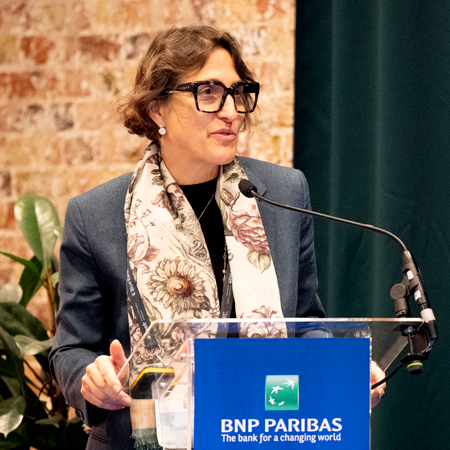
❝ We are no longer debating whether to transition, but how to make it bankable. The challenge is aligning technology readiness, regulation and capital flows so that decarbonisation pathways are not just credible on paper, but investable in practice. ❞
Discussions referenced the work of the UK Transition Finance Council, which is developing guidelines for credible transition financing and sectoral pathways. The Council’s goal is to create a common language between policy, industry and finance — ensuring that investors can differentiate between ambition and genuine delivery.
In Madrid, Sol Hurtado de Mendoza, Managing Director at BNP Paribas Asset Management Iberia, highlighted how today’s web of ESG regulations and the European Commission’s roadmap can often feel like a roller coaster ride – echoed in a recent KPMG report – underscoring the need for clearer and more streamlined rules to accelerate progress on sustainability.
In Tokyo, Mana Nakazora, Vice Chairperson, Global Markets Japan and Chief ESG & Credit Strategist at BNP Paribas Securities Japan, reminded the audience that in the country, Green Transformation (GX) economy transition bonds have been issued and corporate ESG disclosure is being actively promoted, creating expectations of further market growth, while preserving the nuances of Japan’s industrial priorities.
De-risking emerging technologies: partnerships in action
The forums each discussed how public-private partnership can help bring nascent technologies to a stage where they can attract capital. The emerging tech economy has the potential to generate roughly USD 1 trillion of corporate value and to support as many as one million additional jobs throughout Europe by 2030, McKinsey finds. London’s discussion emphasised that de-risking early-stage technologies will require coordinated use of public finance, guarantees and blended structures. Collaboration between banks, institutional investors and government is critical to bring emerging solutions such as hydrogen, industrial electrification, and carbon-capture projects to scale.
Madrid’s speakers described how sustainability can be translated into long-term value when it is supported by economic logic and experience-based collaboration. The Spanish Cooperation Master Plan for Sustainable Development and Global Solidarity (2024‑2027), for example, outlines fresh concepts and approaches that, through coordinated action, enable Spain to confront today’s major global challenges and cement its role as a proactive leader in sustainable development.
According to UNEP’s 2025 Adaptation Gap Report, East Asia and the Pacific bear the highest estimated adaptation costs of any region worldwide. In Tokyo, hybrid GX-bond issuances, backed by future revenue from carbon pricing mechanisms, could unlock early-stage circular economy and climate adaptation projects that would otherwise struggle to mobilise public and private investments. A sign of this momentum came in late October, when Tokyo issued the world’s first certified resilience bond.
The crucial role of ESG data
Reliable, comparable data is the glue that holds the integrated financing ecosystem together and an ESG data strategy is paramount for decision making. London’s forum stressed that consistent transition finance metrics, anchored in the UK Transition Finance Council’s methodology, give investors confidence that a project’s sustainability claims are verifiable and measurable, as noted in a recent Deloitte survey that showed that 97% of UK investors consider a stable policy framework essential and 62 % have a low tolerance for technology‑related risk.
In Madrid, the push for harmonised ESG reporting was presented as a lever of competitiveness in the context of the new international order. The rollout of the country’s Climate Emergency Plan marks a shift from voluntary reporting and growing actions to a compulsory framework that integrates carbon accounting, Scope‑3 emissions, and national resilience strategies.
Tokyo added an Asian perspective: while policy hurdles rise in the United States and Europe, Japan is charting its own path rather than simply following the trans-Atlantic trend. “Swift, confident action is essential because the earth cannot afford delay”, added Nakazora, unveiling that these locally specific standards can be mapped back to the global framework yet retain local relevance. The country has established in 2022 the Sustainability Standards Board of Japan (SSBJ), designed to translate global ESG standards into practical, locally‑tailored implementation.
Enhancing strategic positioning in local markets
When policy, finance and data align, sustainability can become a source of competitive edge for each region. In the UK, the low-carbon infrastructure agenda highlighted by London’s speakers is no longer a niche sustainability issue but a driver of industrial competitiveness and energy security. The UK’s ambition to cut emissions by 81% this decade, Bury said, can only be achieved through integrated financing models that connect policy, technology and capital markets.
Madrid’s dialogue reinforced that the role of the banking industry as a facilitator of its clients’ projects to promote an ecological transition is essential for Europe’s strategic autonomy. Historically, Spain has helped shape EU policies on innovation and industrial competitiveness, and, while holding the EU Council Presidency, it placed reindustrialisation and European strategic autonomy at the centre of the agenda.
Constance Chalchat, Chief Sustainability Officer for Global Markets at BNP Paribas CIB, expanded the narrative in Tokyo, offering a worldwide perspective on the new momentum in sustainability:

❝ Sustainable finance is evolving beyond traditional ESG to become multi-faceted, locally relevant, and aligned with investor priorities, across four key themes: adaptation, conservation, transition and social resilience. ❞
This enlarged investment approach, she added, is purposeful, pragmatic and built for long-term value.
The transition to a sustainable, low-carbon economy requires more than ambition—it demands tangible, coordinated action across policy, finance, and data, tailored to local contexts yet grounded in global standards. The experiences shared at SFF in London, Madrid and Tokyo demonstrate that when these elements align, sustainability can become a strategic advantage, unlocking new sources of value and resilience for businesses and societies alike.