
Interview with Low Carbon Transition Group experts
- Ravina Advani, Head of the Low Carbon Transition Group in the Americas region, Head of Energy Natural Resources and Renewables Coverage in North America (LinkedIn)
- Rachid Bouhamidi, Head of Power and Renewables Debt Advisory and Financing, Europe, Middle East and Africa (EMEA) (LinkedIn)
- Shalen Shivpuri, Head of Energy, Resources and Infrastructure in Asia Pacific (APAC) (LinkedIn)
The latest data of the IEA’s Global Energy Review show that the world’s appetite for energy rose at a faster-than-average pace in 2024. In particular, the demand for electricity rose almost twice as fast as that of the wider energy due to higher cooling, rising consumption by the industrial sector, the electrification of transport and the growth of data centres and artificial intelligence.
With renewable energy playing an increasingly significant role in meeting this rising demand, we spoke to BNP Paribas’ Low Carbon Transition Group experts across three regions to gain insights into the long-term trends in their respective markets, and look at how the financial industry can support this evolution.
Asia-Pacific: a dynamic market and diverse landscape
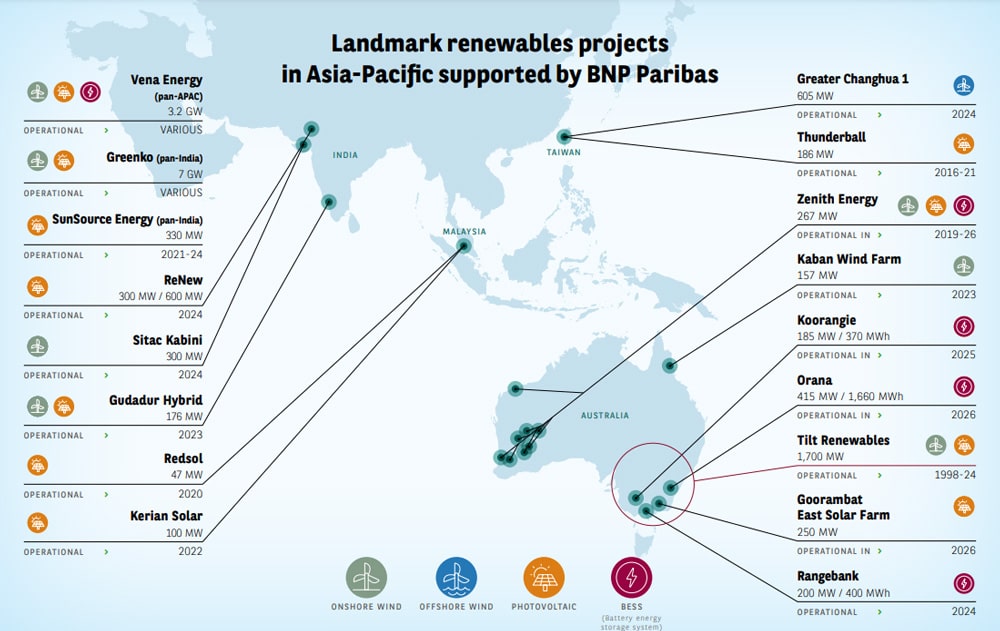
Regulations, currencies, market conditions – the renewable energy landscape in Asia-Pacific is varied in many ways. Geographically smaller countries like Japan, Korea and Taiwan focus on offshore wind projects, while Australia and India rely on solar and onshore wind due to their vast landscapes.
With the region seeing a significant jump in electricity needs, up 6% in 2024, with China and India at the forefront in terms of both demand and clean energy capacity expansion, Shalen Shivpuri discusses the various strategies for renewable energy expansion across APAC and how these are reflected in funding strategies.
“Renewables accounted for about 34% of China’s power mix and 20% of India’s last year. In the first half of 2025, solar power generation in China saw 45% growth, and the share of low-emission sources in the mix was over 40%. The boom has been fuelled by sectors like solar panel manufacturing, batteries, electric vehicles, data centres, and 5G networks.”
He highlights the unique features of the region, as compared to the more uniform markets of the U.S. and EMEA: “A very specific feature of the region is the importance of exchange rates and hedging costs. This means that clients must navigate local liquidity pools and capital markets to find the most cost-effective funding options, while monitoring landed costs and hedging expenses in different local currencies.”

❝ A very specific feature of the region is the importance of exchange rates and hedging costs. This means that clients must navigate local liquidity pools and capital markets to find the most cost-effective funding options, while monitoring landed costs and hedging expenses in different local currencies. ❞
A reliable banking partner is therefore key. Shivpuri continues: “At BNP Paribas, we focus on supporting global clients to effectively deploy their projects, drawing on our strong global expertise combined with an in-depth understanding of the local market.”
In a complex market landscape, knowledge of the full value chain is crucial: “We assist clients along the chain, with developers typically funding their projects initially via project finance followed by a transition to the bond market, facilitating access to diverse liquidity pools, including capital markets, commercial bank financing, and carbon markets.”
EMEA: Modernising the grid will be key priority
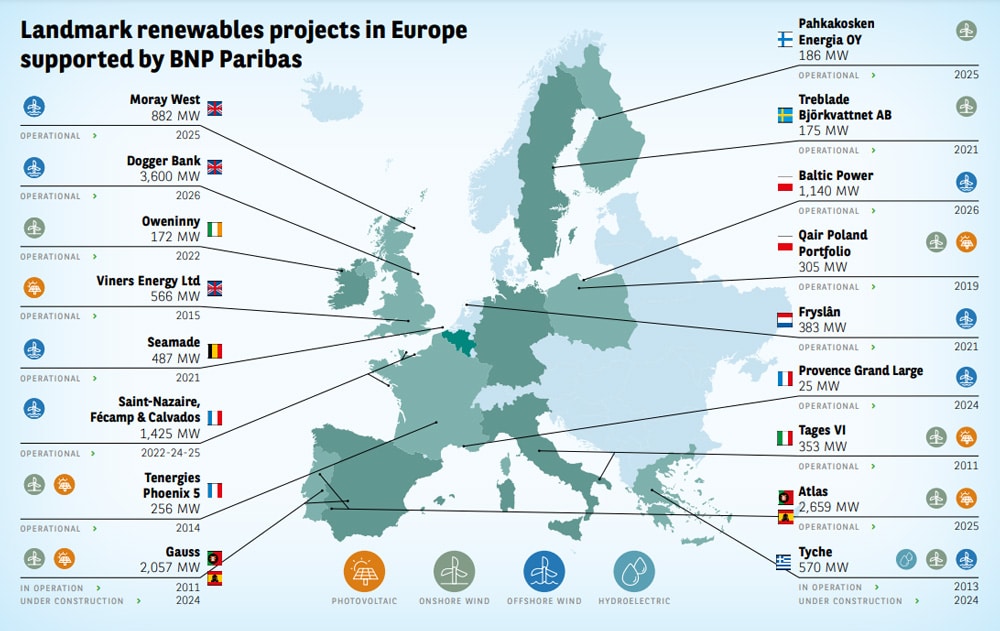
The share of renewables in the energy mix is also rising in the EMEA region, where the International Energy Agency expects the proportion within the European Union’s power supply to increase from 48% to 56% by 2027. This growth is a key lever in the ongoing push towards the electrification of the economies and a key element of the broader low-carbon transition.
Rachid Bouhamidi highlights the various challenges that must be addressed to ensure efficient delivery and use of the rising share of renewables in the power generation mix.
“Offshore wind energy projects are a crucial part of Europe’s energy strategy, with notable projects under way in the UK, France, Poland, Germany, and the Nordics in particular. These projects require significant investment and expertise to manage risks, in particular, those related to construction. Solar and onshore wind projects may require lower capital expenditure per megawatt, but development can be slowed by the permitting process. In this context, a clear, supportive and stable regulatory framework for renewables is of paramount importance to maintain the investment pace and achieve the carbon neutrality objective.”
With renewables accounting for a growing proportion of the energy mix, one of the key priorities in the years ahead is modernising the electricity grid. Grid investments will be central to Europe’s future security and competitiveness.

❝ Over 1,700 gigawatts (GW) of renewable energy projects across 16 countries are waiting to be connected to the electricity grid while at the same time, curtailment of renewable production is becoming a common theme across Europe due to grid constraints or to temporary mismatch between electricity supply and demand. A new approach to system operations and more investments in energy storage infrastructure are needed to support a more flexible and resilient power system. ❞
Bouhamidi highlights: “The results in Italy’s first battery storage auction, MACSE, demonstrate that such investment can be delivered by the private sector at highly competitive terms.”
Renewables have become a well-established and sought-after asset class from institutional investors and large corporates: “Banks play key role in supporting clients throughout the investment process from providing financial advice, loans, risk management products (e.g. inflation and interest rate risks hedging instruments) to bringing projects to international capital markets. A noteworthy example is our collaboration with the European Investment Bank (EIB) to support wind energy projects within the EU with the aim of spurring investment, improving supply chain efficiency and grid interconnections.”
Americas: developing innovative financing solutions
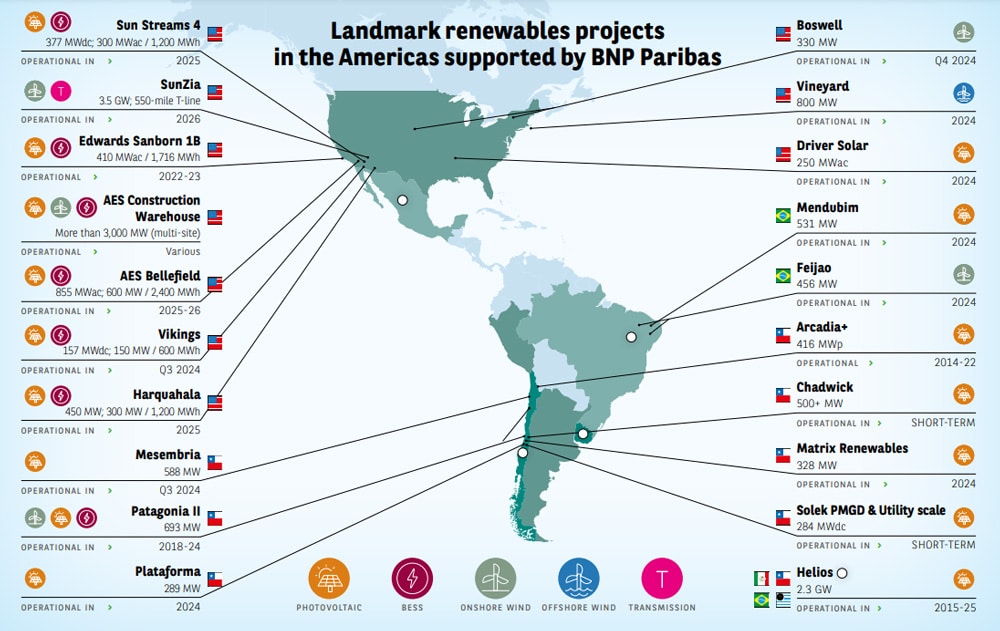
In the Americas, energy companies have consistently built out renewable power capacity over the last decade. Despite a marked shift in the U.S. regulatory framework in the last few months, market fundamentals continue to support the growth of the low carbon transition market. Electrification, the rise of AI, manufacturing, and the ongoing build out of data centres continue to fuel energy demand to new highs, similarly to other regions around the world.
“The Americas region saw a 2.2% rise in electricity demand in 2024, with Brazil, the United States, and Canada leading the charge. Renewable power generation is expanding to meet a large portion of this demand – solar and wind in particular.” Ravina Advani highlights the new challenges that are emerging in response. As an ageing grid and transmission bottlenecks continue to challenge the market’s ability to scale supply, “speed-to-power” is an increasingly existential question. Unprecedented load growth has placed the spotlight on dispatchable generation.”
This, in turn, is driving continued momentum in the energy storage space as well as a resurgence in natural gas-fired generation. As data centers increasingly strain grid reliability and face pressure to decarbonise, nuclear – specifically Small Modular Reactor (SMR) technology – has also emerged as a compelling power solution due to its ability to produce 24/7 dispatchable power. Carbon Capture and Sequestration (CCS) has been gathering pace as a well-supported decarbonisation solution.
Despite headwinds from tariffs and the evolving regulatory framework, renewables continue to offer solutions that are among the fastest to bring online.

❝ Innovative financial solutions are emerging, with private credit investors looking increasingly to low-carbon projects. This growing interest from private credit investors is expanding liquidity for renewable energy projects. ❞
Advani explains: “This collaboration not only enhances the availability of funds but also strengthens the overall financial ecosystem supporting renewable energy initiatives.”
As the industry has evolved, many unique structures have developed as private credit investors focus further on low carbon. Advani continues: “There is a lot of capital pursuing these renewable projects, which speaks volumes about the interest in this asset class. And most excitingly, this truly breeds innovation as we have seen with various technologies.”
BNP Paribas created the Low Carbon Transition Group (LCTG) in 2021. It is a global platform, bringing together an ecosystem of around 250 bankers globally. The LCTG covers all investment banking products, including M&A, strategic advisory, equity raising, and financing, also opening up to breadth of BNP Paribas’ solutions.
It provides tailored advice and optimal capital solutions for each situation, aiming to support the effective decarbonisation of the economy, particularly in the energy, mobility and industrial sectors. The Group is thus developing a multidimensional expertise to support the development of renewables, nuclear, as well as new value chains such as batteries, green hydrogen and low-carbon fuels, as well as CO2 sequestration.
This article is part of the LCTG expert interview series focused on sectors and technologies that are vital for transitioning to a low-carbon economy. Hear from our experts on other topics:
- Batteries, with Vincent Veron, Head of Carbon Transition Minerals, Metals and Batteries
- Carbon capture and storage, with Etienne Didier, Head of Carbon Abatement and Alternative Solutions
- Sustainable fuels, with Roland Kahale, Head of Mid & Downstream Energies
- Low-carbon hydrogen, with Romain Talagrand, Head of Power and Renewable, Project Finance EMEA
Supporting our clients’ transition
Over the past decade, BNP Paribas has consistently been pushing the boundaries of innovation and expertise in sustainable finance to support its clients in their transition. As a Group, BNP Paribas had mobilised EUR179 billion by the end of 2024 to support our customers in their transition to a low-carbon economy. Find more here
Maps source: Energy transition and climate action | BNP Paribas