
Key takeaways:
- US economic growth: Speakers think the US economy seems poised to hit a soft patch while avoiding a recession given its fundamental resilience.
- Inflation: They think the delay in the tariff effect on consumer prices looks due to large inventories that corporations mostly built up and sold at pre-tariff rates.
- The Republican budget bill: A level of certainty with respect to corporate taxation and fiscal policy following the passage of the budget bill.
- Tariffs and supply chains: Corporations are exploring the use of trade-finance tools to ease cash-conversion cycles and promote liquidity throughout supply chains.
- Sectorial exposure to tariffs: Logistics-related sectors, such as the trucking industry, have seen the effect of tariffs, whereas core infrastructure (such as railroads) has been partially shielded.
- Growth strategies: M&A remains a key lever for growth, though some private equity investors believe that companies in the growth stage still need to demonstrate the ability to grow organically.
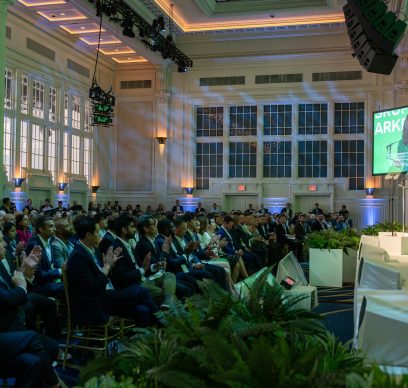
BNP Paribas recently held its inaugural summit for multinational corporate clients (MNCs) in New York, with attendees including CEOs, CFOs, treasurers and financial executives representing world-renowned businesses operating across geographies.
Topics included, among others, the outlook for multinational corporations, the US economy, the impact of tariffs on supply chains, and strategies for confronting this impact—all of which continue to bear relevance into the final quarter of the year.
Economic and geopolitical outlook
Addressing the economic climate and geopolitics, BNP Paribas’ Chief US Economist James Egelhof and Head of US Government and Regulatory Affairs Jeffrey Siegel held a conversation — moderated by Scott Sinawi, Head of Corporate Sales Americas — about tariffs and the US economy and global trade.
Egelhof expects a soft patch of economic growth in the US, though not recession, because of what he believes to be a resilient US economy — one that has already weathered a pandemic and approximately 500 basis points of interest-rate hikes over a multi-year period.
❝ Businesses have been selling inventories at pre-tariff rates — partly to offload their stock, and partly in an effort to build market share. ❞
Inflation may remain entrenched in the economy, although the impact of tariffs on prices has been gradual. Egelhof highlighted that tariffs are beginning to register in inflation data, but their full effect has not yet taken hold, as he believes that businesses had built up very large inventories in anticipation, and they have been selling those inventories at pre-tariff rates — partly to offload their stock, and partly in an effort to build market share.
Egelhof also noted that the passage of the Republican budget bill provided certainty regarding corporate taxation and fiscal policy.
Meanwhile Siegel distinguished between several administration goals for tariffs: 1) specific policy goals; 2) sectoral tariffs on select industries for national security reasons; and 3) reciprocal tariffs to address trade deficits and other concerns about tariff and non-tariff barriers.
❝ As the US sees it, tariffs help address policy goals, national security, trade deficits and other concerns about tariff and non-tariff barriers. ❞
Supply-chain challenges and trade-finance solutions
The conference moved on to a new panel of supply-chain experts who examined the consequences of tariffs for logistics and operations; explored how ports, stations, and logistics centres are adapting to the new landscape; and exchanged insights into the trends, challenges, and opportunities emerging in this critical space for multinational corporations.
Moderated by Swati Rao, Head of Transportation & Infrastructure Investment Banking at BNP Paribas, panellists included Kevin McBrien, Managing Director of Global Trade Solutions Americas at BNP Paribas, and executives from the asset management, logistics and transportation sectors.
According to McBrien, clients are increasingly exploring the use of trade-finance tools to ease cash-conversion cycles (the length of time it takes a company to convert the cash spent on inventory back into cash from selling products), and make sure there is enough liquidity throughout their supply chains, with the ultimate objectives of reducing disruptions and increasing resilience and efficiency.
❝ In response to the margin compression caused by tariffs, companies are trying to ease cash-conversion cycles and maintain sufficient liquidity throughout their supply chains. ❞
Another expert noted that tariffs are affecting logistics-related sectors, such as the trucking industry. Yet their effect on core infrastructure — such as railroads, which transport a diverse set of products and are therefore partially shielded from macroeconomic policy — has not been as pronounced.
One partner at a private equity firm specialising in growth-oriented businesses noted that financial sponsors are holding onto their investments longer. From his perspective, M&A will always be a viable lever to be used in pursuit of growth throughout market cycles, but companies should also demonstrate the ability to grow organically.
BNP Paribas’ tenured partnerships with multinational clients
Aurélia Normand, Head of Global Transaction Banking and Global Head of Network Banking at BNP Paribas CIB, capped the summit with closing remarks on the Bank’s long-term partnerships with multinational clients throughout the market cycles. This partnership, she said, is manifest in sharing the Bank’s views, arranging for peer discussions to exchange perspectives, and providing a range of solutions to address working capital, liquidity, hedging, risk management and other matters toward helping clients chart a path forward amid unfamiliar and often volatile circumstances.
❝ BNP Paribas seeks to accompany our multinational clients throughout market cycles. We share our views, arrange for peer discussions to exchange perspectives and provide a range of solutions to address working capital, liquidity, hedging, risk management and other matters toward helping clients chart a path forward amid unfamiliar and often volatile circumstances. ❞